
Beauty Subscription Box Profit Calculator
Financial Breakdown
You see the glossy unboxing videos on social media. You see the sleek branding of Birchbox, Ipsy, and countless niche competitors. It looks like a money-printing machine: customers pay monthly, you send them products, everyone is happy. But here is the hard truth that most startup guides skip: subscription box owners often lose money in their first two years. The question isn't just "how much can you make?" but rather, "what does it take to stop bleeding cash and start profiting?"
In 2026, the beauty subscription market is saturated but still growing. The winners aren't the ones with the prettiest packaging; they are the ones who master unit economics. If you are thinking about launching a beauty box, or if you are already running one and wondering why your bank account doesn't reflect your subscriber count, this breakdown will show you exactly where the money goes-and how to keep some of it.
The Revenue Reality: What Subscribers Actually Pay
Let's look at the top line first. In the beauty vertical, the average monthly subscription price sits between $15 and $30. Premium boxes featuring full-size luxury items can command $50 to $100 per month, but these require significantly higher operational complexity. For the sake of this analysis, let's assume a standard mid-tier box priced at $25 per month.
If you have 1,000 active subscribers, your gross monthly revenue is $25,000. This sounds impressive until you realize that this number is purely theoretical. It assumes zero cancellations, zero failed credit card transactions, and zero refunds. In reality, payment failures alone can eat up 2% to 4% of your potential revenue. A "dormant" subscriber who hasn't paid in three months is still counted as an active user by many platforms, inflating your perceived success.
To get a realistic picture, you need to calculate your Monthly Recurring Revenue (MRR). This is the predictable revenue you actually collect. If your payment failure rate is 3%, your real MRR from those 1,000 subscribers is $24,250. That missing $750 might seem small, but over a year, it adds up to nearly $9,000 in lost income-money you cannot spend on marketing or product development.
The Hidden Costs: Why Your Margins Are Shrinking
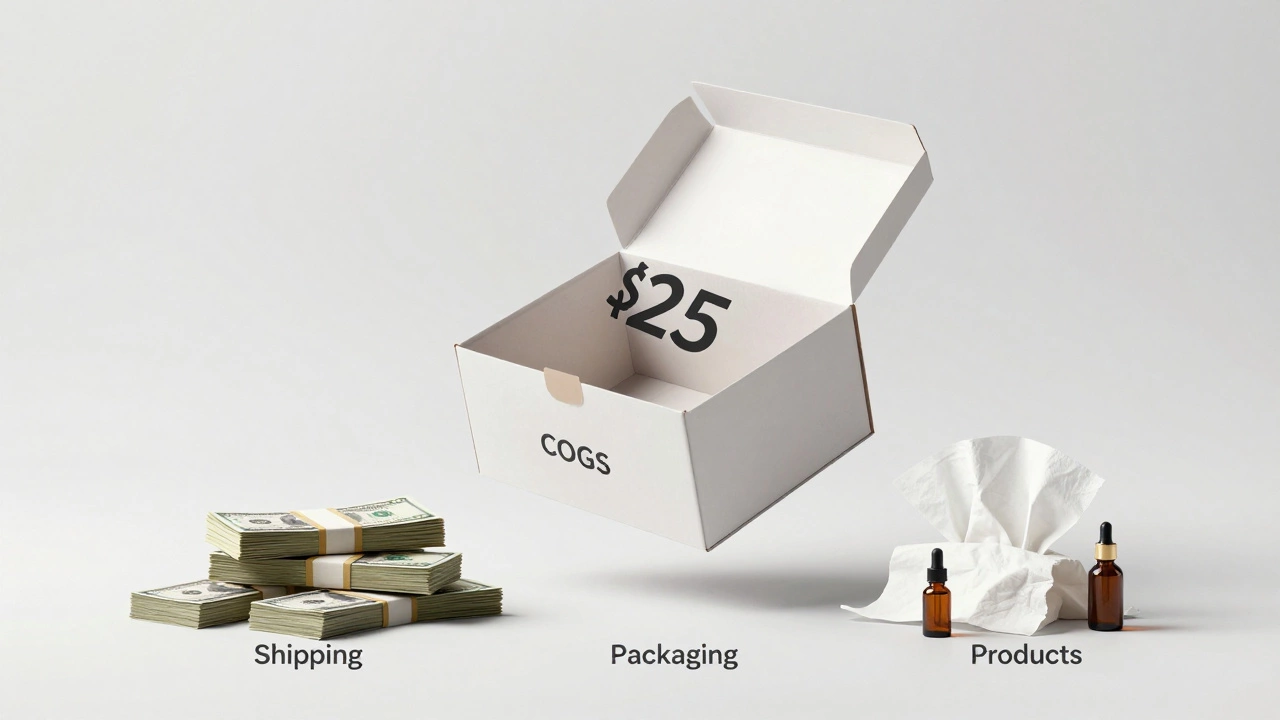
Revenue is vanity; profit is sanity. The biggest mistake new box owners make is underestimating the Cost of Goods Sold (COGS). COGS includes more than just the products inside the box. It includes:
- Product Sourcing: Wholesale costs for the beauty items.
- Packaging: The box itself, tissue paper, stickers, and inserts.
- Labor: Time spent picking, packing, and quality-checking each box.
- Shipping: Carrier fees, fuel surcharges, and dimensional weight charges.
For a $25 box, a healthy COGS should be around $10 to $12. This means you are spending $10 on the actual makeup or skincare items, $2 on packaging materials, and $3 to $4 on shipping. If your COGS exceeds $15 per box, you are operating on razor-thin margins. Any unexpected spike in shipping rates or product costs will push you into the red.
Consider the labor aspect. If you pack boxes yourself, you are likely undercharging for your time. Professional packers charge $15 to $20 per hour. If it takes you 10 minutes to pack one box, that's $2.50 to $3.33 in labor cost per box. Many founders ignore this, treating their own time as free, which leads to unsustainable business models.
| Cost Category | Estimated Cost Per Box | Percentage of Revenue |
|---|---|---|
| Wholesale Products | $8.00 - $10.00 | 32% - 40% |
| Packaging Materials | $1.50 - $2.50 | 6% - 10% |
| Shipping & Handling | $3.00 - $4.50 | 12% - 18% |
| Labor (Packing) | $2.00 - $3.00 | 8% - 12% |
| Total COGS | $14.50 - $20.00 | 58% - 80% |
As you can see, if your total COGS hits $20, you only have $5 left from that $25 sale. That $5 must cover your marketing, software subscriptions, customer support, and taxes. This is why many box owners struggle to scale without raising prices or cutting corners on product quality.
Marketing Spend: The Customer Acquisition Trap
Even if you have perfect margins, you need new customers to grow. This is where Customer Acquisition Cost (CAC) comes into play. In 2026, digital advertising costs have risen across all platforms. Facebook and Instagram ads, once the bread and butter of beauty brands, now face increased competition and privacy restrictions that make targeting harder.
A typical CAC for a beauty subscription box ranges from $15 to $40 per new subscriber. Let's say your CAC is $25. You acquire a customer for $25, and they pay you $25 in their first month. Did you break even? No. You still have to pay for their box ($15 COGS), so you are actually down $15 in the first month. It takes at least two to three months of retention just to recover your initial marketing investment.
This is known as the payback period. If your payback period is longer than six months, investors and banks will view your business as high-risk. To lower CAC, successful box owners rely heavily on organic content, influencer partnerships, and referral programs. Instead of paying for every click, they build a community that brings in friends for free.
The Churn Factor: Why Retention Is King
Churn is the percentage of subscribers who cancel their service each month. In the subscription industry, churn is the silent killer. A 5% monthly churn rate sounds manageable, but it means you lose half of your customer base every year. If you don't replace those customers, your revenue declines despite having a "growing" business on paper.
Beauty boxes suffer from higher churn than utility services because they are discretionary spending. When economic uncertainty rises, consumers cut back on non-essential luxuries first. The average churn rate for beauty subscription boxes hovers between 4% and 7% per month. Top-performing companies manage to keep this below 3% through exceptional curation and personalized experiences.
To combat churn, you must focus on Lifetime Value (LTV). LTV is the total amount of money a customer spends with you before cancelling. If a customer stays for 12 months and pays $25/month, their LTV is $300. After subtracting COGS ($15 x 12 = $180) and CAC ($25), your net profit per customer is $95. This margin allows you to reinvest in growth and improve your offerings.

Profit Scenarios: How Much Can You Actually Keep?
Let's run the numbers for three different scenarios based on 1,000 active subscribers. These examples assume a $25 monthly price point and a 5% monthly churn rate.
Scenario 1: The Struggling Startup
High COGS ($18/box), High CAC ($35/customer), Low Retention (5% churn).
Monthly Revenue: $25,000
COGS: $18,000
Marketing (to replace churn): $1,750 (35 new customers x $35)
Other Expenses (Software, Support): $1,000
Net Profit: $4,250 (17% Margin)
Scenario 2: The Efficient Operator
Optimized COGS ($12/box), Moderate CAC ($20/customer via referrals), Good Retention (3% churn).
Monthly Revenue: $25,000
COGS: $12,000
Marketing: $600 (30 new customers x $20)
Other Expenses: $1,000
Net Profit: $11,400 (45.6% Margin)
Scenario 3: The Premium Brand
Higher Price ($40/box), Higher COGS ($20/box), Lower CAC ($15/customer due to brand loyalty), Best Retention (2% churn).
Monthly Revenue: $40,000
COGS: $20,000
Marketing: $300 (20 new customers x $15)
Other Expenses: $1,500
Net Profit: $18,200 (45.5% Margin)
Notice that Scenario 2 and 3 yield similar profit margins, but Scenario 3 generates significantly more absolute profit due to higher pricing power. However, achieving premium status requires stronger branding and higher-quality products, which increases risk upfront.
Scaling Up: From Hobby to Business
Once you hit profitability with 1,000 subscribers, scaling becomes both easier and harder. Easier because you have proven unit economics. Harder because operational bottlenecks appear. Can your supplier handle 10,000 units? Can your packing team keep up? Does your customer support system collapse under volume?
Most successful box owners automate their fulfillment process early on. Using third-party logistics (3PL) providers can reduce shipping costs and eliminate the need for manual packing labor. While this increases COGS slightly, it frees up your time to focus on marketing and product curation-the areas that directly impact growth.
Additionally, diversifying revenue streams helps stabilize income. Many box owners introduce one-time purchase options, allowing subscribers to buy individual products featured in previous boxes. This captures value from lapsed subscribers and provides an additional revenue channel that isn't dependent on monthly billing cycles.
Is starting a beauty subscription box profitable in 2026?
Yes, but only if you control your costs. With rising advertising prices and consumer fatigue, profitability depends on maintaining a low Customer Acquisition Cost (CAC) and keeping churn below 5%. Most new owners do not see significant profits until they reach 2,000+ subscribers and optimize their supply chain.
What is the average profit margin for a subscription box?
Healthy subscription box businesses typically aim for net profit margins between 20% and 40%. Margins below 15% are considered risky because they leave little room for error in shipping costs or marketing spend. Premium boxes can achieve higher margins if they maintain strong brand loyalty.
How much does it cost to ship a beauty box?
Shipping costs vary by weight and dimensions. For a standard domestic US box under 2 pounds, expect to pay between $3 and $6 depending on carrier negotiations. International shipping can double or triple these costs. Using regional distribution centers can help reduce last-mile delivery expenses.
Why do so many subscription boxes fail?
The primary reasons are high churn rates and unsustainable Customer Acquisition Costs. Many founders underestimate the effort required to retain customers month after month. Additionally, failing to negotiate better wholesale prices as volume grows leads to shrinking margins that eventually cause bankruptcy.
How can I lower my customer acquisition cost?
Focus on organic growth strategies such as SEO, social media content, and referral programs. Partnering with micro-influencers who offer commission-based deals rather than flat fees can also reduce upfront marketing spend. Building an email list allows you to re-engage users without paying for ad impressions.
 Skincare