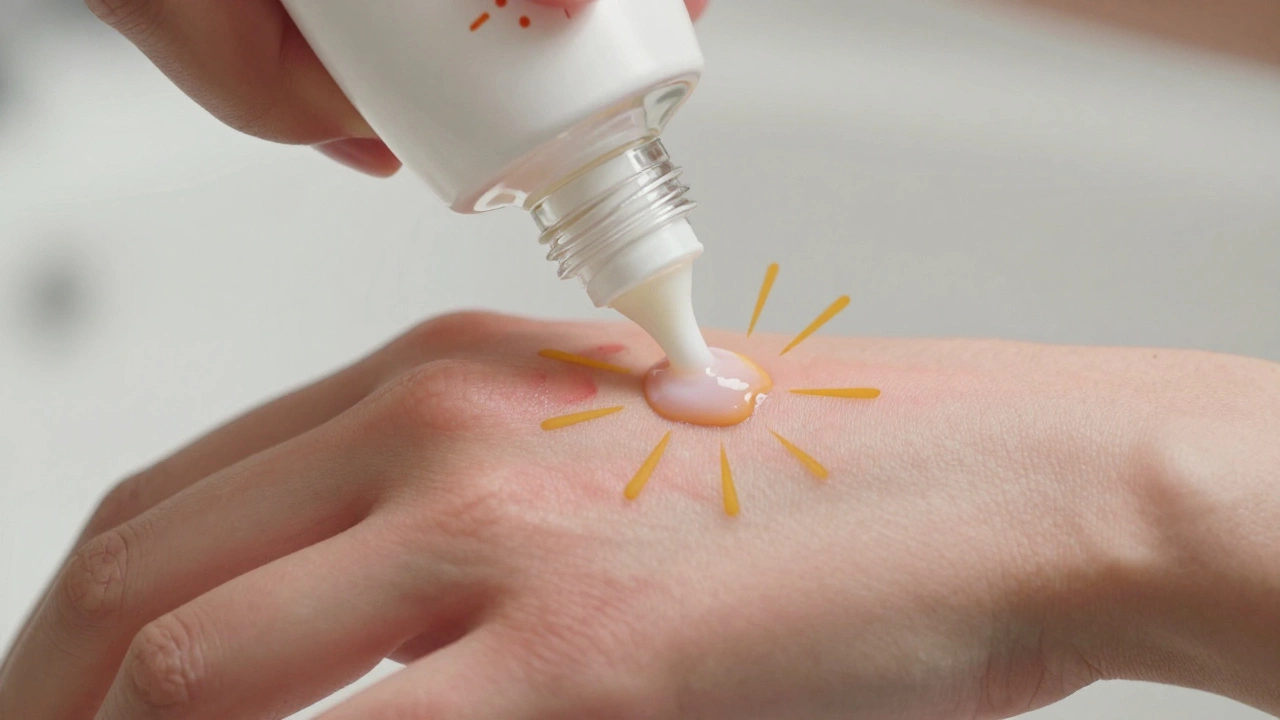
Sunscreen Application Calculator
Calculate how much sunscreen you need to apply for proper protection against UV radiation. Proper application is essential for sunscreen to work effectively as a protective medical product.
Your Application Settings
Why Proper Application Matters
Sunscreen is a medical product - just like your prescription medication, it needs proper application to be effective. Many people apply only 25-50% of the recommended amount, which drastically reduces protection.
Remember: 1 teaspoon for your face and neck, 1/2 teaspoon for each arm, and 1 teaspoon for each leg or torso area.
Because sunscreen is regulated as a drug (not just a cosmetic), its effectiveness depends on using the right amount. This is why proper application is critical for skin cancer prevention.
Recommended Amount
(Based on standard Australian sunscreen application guidelines)
Apply 1 teaspoon for your face and neck, 1/2 teaspoon for each arm, and 1 teaspoon for each leg or torso area.
Ever looked at your sunscreen bottle and wondered if it’s really a cosmetic? You’re not alone. Most people assume it’s just another skincare product-something you slap on before heading out. But here’s the twist: sunscreen isn’t just a cosmetic. In many countries, including Australia and the United States, it’s legally classified as a drug. And that changes everything about how it’s made, tested, and sold.
What Makes Something a Cosmetic?
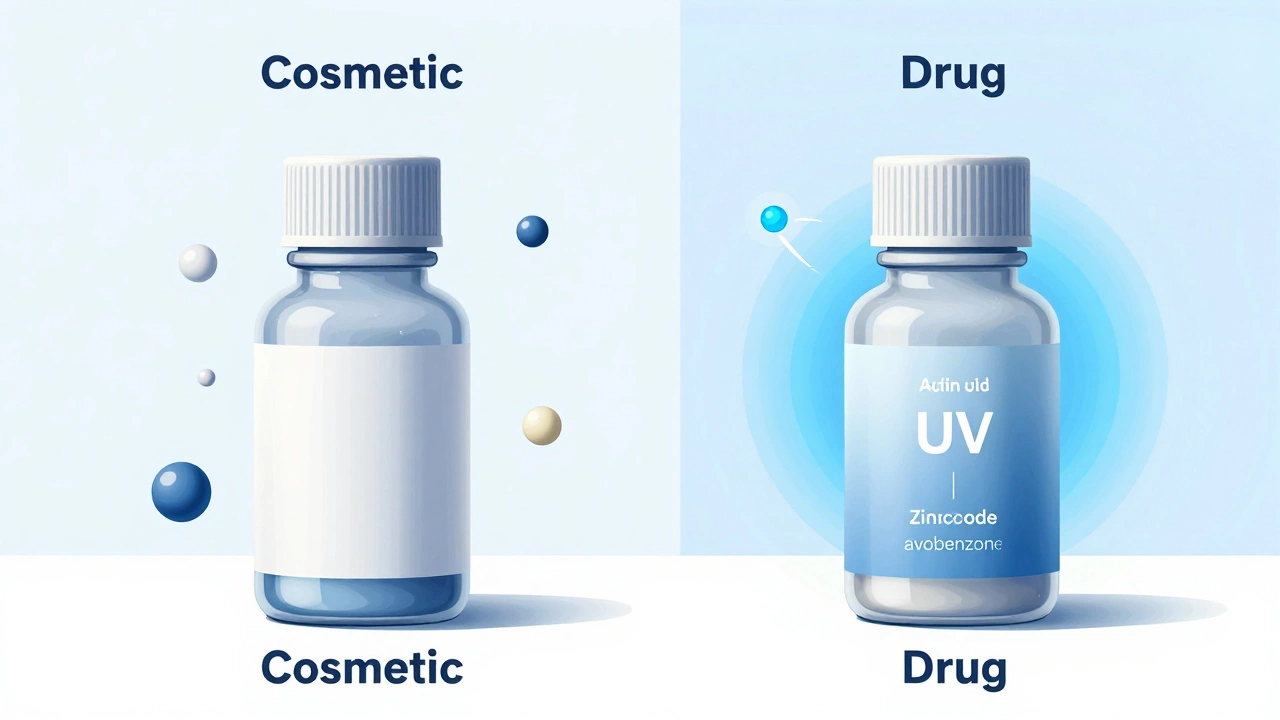
The term cosmetic sounds simple: anything you use to clean, beautify, or alter your appearance. That includes foundation, lipstick, shampoo, and body lotion. The U.S. Food and Drug Administration (FDA) defines cosmetics as products intended to be applied to the human body for cleansing, beautifying, promoting attractiveness, or altering the appearance-without affecting the body’s structure or function.
So if a product only changes how you look-like making your skin glow or covering a blemish-it’s a cosmetic. But if it changes how your skin works? That’s not cosmetic anymore. That’s a drug.
How Sunscreen Breaks the Cosmetic Rule
Sunscreen doesn’t just make your skin look better. It protects your skin from UV radiation, which damages DNA and can lead to skin cancer. It does this by using active ingredients like zinc oxide, titanium dioxide, avobenzone, or octinoxate that absorb or reflect ultraviolet rays. These ingredients don’t sit on the surface-they interact with light and alter the biological process of sun damage.
That’s not beautifying. That’s preventing disease.
In Australia, the Therapeutic Goods Administration (TGA) classifies sunscreen as a therapeutic good. In the U.S., the FDA treats it as an over-the-counter (OTC) drug. In the European Union, it’s regulated under the Cosmetics Regulation but with strict drug-like testing requirements for SPF claims. No matter where you are, sunscreen has to meet higher standards than your blush or body wash.
Why the Classification Matters
If sunscreen were just a cosmetic, manufacturers wouldn’t need to prove it works. They wouldn’t need to list exact SPF numbers or undergo clinical testing. They could say “offers sun protection” without showing data. But because it’s a drug or therapeutic product, every bottle must pass strict tests.
Here’s what that means in practice:
- Sunscreen must be tested on humans to prove it delivers the SPF claimed on the label.
- Manufacturers must submit data to regulators before selling it.
- Ingredients must be approved and listed in specific concentrations.
- Claims like “broad spectrum” or “water resistant” are legally defined and must be backed by evidence.
Compare that to a moisturizer labeled “brightens skin.” No testing required. No proof needed. That’s cosmetic territory. Sunscreen? You’re getting a product that’s been clinically validated.
What About Tinted Sunscreens or SPF Foundations?
You’ve probably seen tinted moisturizers with SPF 30, or foundations that claim sun protection. Are those cosmetics? Technically, yes-if they’re marketed only for color and coverage. But if they make an SPF claim, they’re no longer just cosmetics. They’re regulated as drugs.
In Australia, any product that claims SPF-even if it’s a foundation-must be listed with the TGA. In the U.S., the FDA requires those products to follow OTC drug monographs. That means even your “beauty product with SPF” has to go through the same testing as a plain white sunscreen.
That’s why you’ll see a “Drug Facts” panel on tinted sunscreens. It’s the same one you’d find on aspirin or antacids. That’s not a marketing gimmick. That’s the law.
Why People Get Confused
Sunscreen sits in the skincare aisle next to serums and toners. It’s sold in beauty stores. Influencers talk about it like it’s part of a glow-up routine. And because it’s often formulated to feel lightweight or look invisible, it’s easy to think it’s just another cosmetic.
But here’s the reality: you don’t use sunscreen because you want your skin to look prettier. You use it because you don’t want to get skin cancer. You use it because your skin burns. You use it because the sun is damaging your skin right now, even on cloudy days.
That’s not beauty. That’s prevention.
The Global Picture
Regulations vary slightly by country, but the core idea stays the same:
| Country/Region | Classification | Regulating Body |
|---|---|---|
| Australia | Therapeutic Good | Therapeutic Goods Administration (TGA) |
| United States | Over-the-Counter Drug | Food and Drug Administration (FDA) |
| European Union | Cosmetic with Drug-like Requirements | European Commission |
| Japan | Quasi-Drug | Ministry of Health, Labour and Welfare |
| Canada | Drug | Health Canada |
Even in places where sunscreen is technically labeled a cosmetic, regulators demand proof of effectiveness. You can’t just slap an SPF number on a bottle and call it a day. That’s why you rarely see fake SPF products on shelves in these countries. The rules are too strict.
What This Means for You
If you’re buying sunscreen, you’re not choosing a beauty product. You’re choosing a medical device for your skin’s health. That means:
- Check the label for active ingredients, not just “SPF 50” marketing.
- Look for “broad spectrum” to ensure UVA and UVB protection.
- Don’t trust products that say “sun protection” without an SPF number.
- Reapply every two hours-no matter how fancy the bottle looks.
And if you’re using a tinted product with SPF? Treat it like your regular sunscreen. Don’t assume a little color means you’re protected. You still need a full teaspoon for your face and neck.
The Bigger Picture
Classifying sunscreen as a drug isn’t bureaucracy-it’s protection. Skin cancer is the most common cancer in Australia. One in two Australians will develop skin cancer by age 70. That’s not a scare tactic. That’s a statistic from the Cancer Council Australia.
When sunscreen is treated like a cosmetic, people underestimate it. They use too little. They skip reapplication. They think “it’s just makeup.” But when it’s regulated as a drug, the system forces transparency. It forces accountability. It saves lives.
So next time you reach for your sunscreen, don’t think of it as part of your beauty routine. Think of it as your daily shield. Your body’s first line of defense. Not because it makes you look good. But because it keeps you alive.
Is sunscreen a cosmetic or a drug?
Sunscreen is not a cosmetic-it’s classified as a drug or therapeutic good in most countries, including Australia, the U.S., and Canada. This is because it changes how your skin functions by protecting against UV radiation, which can cause skin cancer. Cosmetics only alter appearance, while sunscreen prevents biological damage.
Why does it matter if sunscreen is a drug?
It matters because drugs have to prove they work. Sunscreen manufacturers must run clinical tests to prove their SPF claims, list exact active ingredients, and meet strict safety standards. Cosmetics don’t need this level of proof. If sunscreen were just a cosmetic, you couldn’t trust the SPF number on the bottle.
Can tinted moisturizers with SPF be trusted as sunscreen?
Yes-if they’re regulated as a drug. In Australia and the U.S., any product making an SPF claim must be approved by health regulators and display a Drug Facts panel. But many people use too little of these products, so they don’t get full protection. Always apply the same amount as you would regular sunscreen: about a teaspoon for your face and neck.
Does sunscreen need to be tested on humans?
Yes. In Australia and the U.S., sunscreen must undergo human testing to confirm SPF and broad-spectrum protection. Labs use controlled UV exposure on volunteers to measure how much UV radiation gets through the product. This is not required for cosmetics.
Why do some sunscreens say “cosmetic” on the label?
Some products, especially in the EU, are labeled as cosmetics because the region’s rules allow it-but they still must meet drug-like testing standards. It’s a legal loophole in labeling, not in function. Always check for SPF numbers and broad-spectrum claims, not just the word “cosmetic.”
 Skincare