
Skincare Routine Checker
Check which of the 3 essential skincare routines you're missing. For each routine, select all steps you currently do.
Your Routine Analysis
Most people think skincare is complicated. You see ads for 10-step routines, serums with five-syllable names, and devices that cost more than a phone. But here’s the truth: you don’t need any of that. The real foundation of healthy skin is built on just three simple steps-done right, every day.
Morning: Cleanse, Protect, Hydrate
Your skin wakes up overnight with oil, dead cells, and environmental gunk stuck to it. A gentle cleanser is all you need. No scrubbing. No hot water. Just lukewarm water and a soft foam or cream cleanser. Over-cleansing strips your skin’s natural barrier, which makes it dry, red, and more sensitive.
After cleansing, you apply moisturizer. Not because your skin is dry, but because your barrier needs support. Even oily skin needs hydration. Look for something lightweight with hyaluronic acid or glycerin. These ingredients pull water into your skin without clogging pores.
Then comes the most important step: sunscreen. Not a moisturizer with SPF. Not a tinted BB cream with ‘some’ protection. A dedicated sunscreen with SPF 30 or higher, reapplied every two hours if you’re outside. UV rays are the #1 cause of wrinkles, dark spots, and skin cancer. Skipping this step undoes everything else you do. A 2023 study in the Journal of the American Academy of Dermatology showed people who used daily sunscreen had 24% less skin aging after four years than those who didn’t.
Nighttime: Cleanse, Repair, Nourish
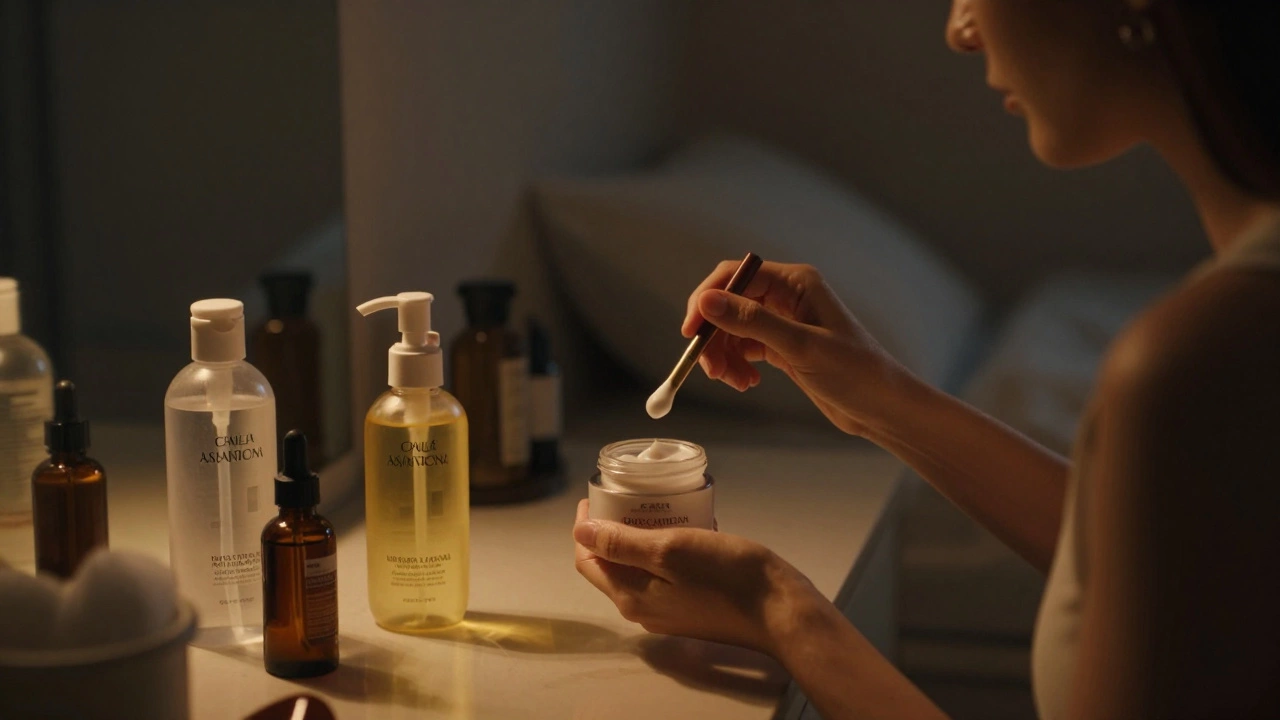
At night, your skin switches into repair mode. But it can’t do that if it’s covered in makeup, sweat, and pollution from the day. Double cleansing works best here. First, use an oil-based cleanser or micellar water to dissolve sunscreen and makeup. Then follow with your regular water-based cleanser to remove what’s left. This ensures your skin is truly clean before you apply anything else.
Now comes your active treatment. This isn’t optional. If you only do one thing at night, make it retinol. Retinol is the most proven ingredient for boosting cell turnover, reducing fine lines, and clearing acne. Start with a low concentration-0.025%-two to three nights a week. Your skin might peel or feel tight at first. That’s normal. It’s not irritation; it’s adaptation. After four to six weeks, your skin will adjust. You’ll see smoother texture and fewer breakouts.
Finish with a thicker moisturizer. Look for ceramides, squalane, or niacinamide. These repair your skin barrier while you sleep. Ceramides are lipids your skin naturally makes, but they drop as you age. Replacing them helps lock in moisture and stop redness. Niacinamide reduces inflammation and evens out tone. You don’t need five serums. One good night cream does the job.
Weekly: Exfoliate, Soothe, Reset
Twice a week, your skin needs a reset. That’s when you add exfoliation. But not physical scrubs with walnut shells or plastic beads. Those scratch your skin and cause micro-tears. Use chemical exfoliants instead-AHAs like glycolic or lactic acid for surface texture, or BHAs like salicylic acid for clogged pores.
Apply it after cleansing and before moisturizer. Wait 10 minutes, then follow with your night cream. Don’t use retinol and exfoliants on the same night. That’s a recipe for irritation. Alternate them: one night exfoliate, the next night retinol. Give your skin a break in between.
After exfoliating, your skin is more sensitive. That’s why you need a soothing mask or serum. Look for centella asiatica, aloe vera, or panthenol. These calm redness and repair damage. A 2024 clinical trial found that using a centella-based serum twice a week reduced skin sensitivity by 68% in people with reactive skin.
What to Skip
Here’s what doesn’t belong in a basic routine:
- Essential oils (they’re irritating and unregulated)
- Alcohol-based toners (they dry out your barrier)
- Over-exfoliating (more than twice a week damages skin)
- Layering too many actives (vitamin C + retinol + niacinamide + AHA = meltdown)
- Expensive ‘miracle’ creams with no proven ingredients
You don’t need a $200 serum to get results. You need consistency. A $12 retinol cream used every night for six months will outperform a $150 one used once a week.
Real-Life Example
Sarah, 32, had constant breakouts and dull skin. She tried every trend: jade rollers, ice facials, charcoal masks. Nothing worked. Then she simplified. Every morning: gentle cleanser, hyaluronic acid serum, SPF 30. Every night: oil cleanser, water cleanser, 0.025% retinol, ceramide cream. Twice a week: lactic acid toner, centella mask.
Three months later, her acne cleared. Her skin looked brighter. Her dermatologist said her barrier was stronger than most people her age. She didn’t buy a single new product after the first week. She just stuck to the three routines.
Common Mistakes
People mess up the basics in predictable ways:
- Skipping sunscreen because it’s cloudy. UV rays penetrate clouds. You need it even on gray days.
- Using the same product for morning and night. Your skin has different needs. Night is for repair, day is for defense.
- Waiting for results in a week. Skin turnover takes 28 days. You won’t see changes until after four weeks.
- Adding new products too fast. Introduce one new thing every three weeks. Otherwise, you won’t know what’s working-or causing irritation.
What If You Have Sensitive Skin?
You still follow the same three routines. Just go slower.
- Cleanser: Fragrance-free, soap-free, labeled ‘for sensitive skin’
- Sunscreen: Mineral-based (zinc oxide or titanium dioxide)
- Retinol: Start with 0.01% once a week, then build up
- Exfoliation: Only once a week, use lactic acid (gentler than glycolic)
If your skin stings, stop everything. Use only moisturizer and sunscreen for five days. Then reintroduce one product at a time.
Final Thought
Skincare isn’t about buying more. It’s about doing less-well. The three routines above have worked for millions because they’re backed by science, not marketing. You don’t need a cabinet full of bottles. You need three habits. Do them every day. Don’t skip sunscreen. Don’t overdo it. And give your skin time to respond.
Healthy skin isn’t a luxury. It’s the result of simple, consistent care.
What are the 3 basic skincare routines?
The three basic skincare routines are: 1) Morning-cleanse, hydrate, apply sunscreen; 2) Nighttime-double cleanse, repair with retinol or similar, nourish with a rich moisturizer; 3) Weekly-exfoliate gently twice a week, then soothe with calming ingredients like centella or aloe vera. These steps form the foundation of healthy skin without needing dozens of products.
Can I skip sunscreen if I’m indoors all day?
No. UVA rays penetrate windows and cause aging even when you’re inside. Studies show daily sunscreen use reduces signs of aging by 24% over four years. If you’re near a window, on your phone, or working at a desk, you’re still exposed. Use a lightweight SPF 30 every morning, no exceptions.
Do I need to use retinol?
Retinol isn’t mandatory, but it’s the most effective anti-aging and acne-fighting ingredient proven by decades of research. If you’re over 25, your skin’s natural cell turnover slows down. Retinol fixes that. Start low and slow. If you can’t tolerate it, try bakuchiol-a plant-based alternative with similar results but less irritation.
How long until I see results from a basic skincare routine?
Skin renews itself every 28 days. You’ll notice small improvements-like less redness or smoother texture-in about three weeks. Clearer skin and fewer fine lines usually show up after 8 to 12 weeks. Patience is key. Quick fixes don’t last. Consistency does.
Can I use the same moisturizer morning and night?
You can, but you shouldn’t. Morning moisturizers should be light and work under sunscreen. Night moisturizers should be richer to support repair. Using a heavy cream in the morning can make sunscreen slide off. Using a thin gel at night won’t give your skin enough barrier support. Two different formulas are better than one compromise.
Is exfoliating every day better for my skin?
No. Exfoliating daily strips your skin’s protective barrier, leading to dryness, irritation, and increased sensitivity. Even dermatologists recommend chemical exfoliants no more than twice a week. Over-exfoliating triggers inflammation, which accelerates aging. Less is more-especially with skin.
 Skincare